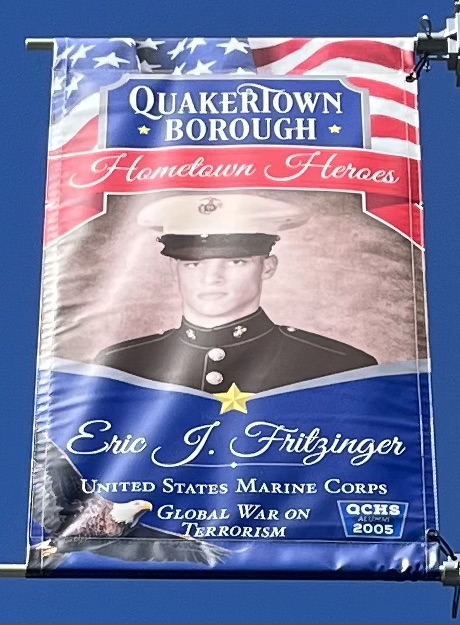
Marine Corporal Eric Fritzinger was a 17 year old high school graduate in 2005 when he told his parents he wanted to enlist in the Marines. He needed their permission because he was under age. First, they said no, but relented when he said he would go in on his own when he was eighteen. A month after graduating he was in Marine boot camp on Parris Island. He was a freshman in high school when 9/11 happened. He was in an assembly about domestic terrorism when the planes hit the World Trade Center.
“When 9/11 happened, it changed me personally, but watching those towers fall. Something lit inside me. It wasn’t about revenge or anything. It was about protecting people. I knew I didn’t want to be on the sidelines. I wanted to be where the fight was to stand up for the American people.”
Eric and I met on a sunny morning on the outdoor patio of a Paneras. He is soft spoken and looks like a former Marine with short hair and a solid build. He was late for our appointment and I thought he wasn’t coming. I was walking out to the parking lot when he pulled up in his truck and called my name. I’m glad he caught me.
Eric is part of the 9/11 generation. The teenagers and twenty somethings who volunteered to go off to war. A decision that would cost many their lives and haunt the survivors for the rest of their lives. Old men make decisions to go to war. Young men and women pay the price.
Eric was sent to Iraq and was in the center of one of the big battles of the war in Ramadi. I asked if he was afraid during his first fire fight. He spoke in a calm voice.
“It was just, my reaction was to react to that…that’s what Marines are always taught. You know to locate the enemy and neutralize it”
How long did it last?
“It seemed like forever, but it was probably around maybe five minutes. You know when you first get there you are kind of nervous, you’re scared. You’re trying to comprehend everything you see. It becomes normalized. And, then at the end you don’t want to die because you’re going home.”
After about a year in Iraq, he went on to become a team leader which meant more training. As happens in the military, things changed. He was then sent to Afghanistan.
“It hit, man. It hit me hard, harder because we were supposed to go on duty on a navy ship where you go to different ports.”
Eric served in Hellman Province near the Pakistan border fighting the Taliban. He went through combat for about two months.
What kind of reaction were you getting from people in both Iraq and Afghanistan?
“Oh, I always say they smile to your face, but you know you can’t trust them…they’ll stab you in the back.”
It must be difficult not being able to trust the people you were trying to help?
“Correct, yeah. I think we played with the kids more than anything.” He said with a smile.
Eric was discharged after four years in the Marines. He lost friends over there. It changed his life.
“So when you get out, and you get back to the real normal. You know as opposed to the normalized over there. When you leave the battlefield, you don’t just walk away from war. It haunts you til the day you die. In combat, everything was easy. You had one job, and one purpose being there. Everyday you wake up with a mission. Complete the mission and survive. You adjust so much to the horrific things you saw over there, and then back home, and your life has paused, while the rest of the world keeps going.”
“You continue each day to receive the sense of war. The sudden smell of death, the sound of a loud boom brings a flashback to war. I still feel disconnected to the world around me, numb a lot of the time.”
I asked about the impact on his relationships. “I have become isolated, self sufficient in a way. I depend only on myself. I’m closed off with most of my family and changed in a way that I will never be the same. Most of my friends have not reached out to me for years, because I have stopped answering their calls.”
Eric seems like a man alone resigned to the life after war. He said there is not a formal transition back to civilian life. He went to the VA and was diagnosed with TBI, traumatic brain injury and has been on changing medication for years. He was having trouble expressing himself. Dealing with the VA has been frustrating. Eric still suffers from migraine headaches. He’s given up on the VA really helping him. He seems resigned to his changed life.
While suffering the after effects of war, Eric attended Penn State after being discharged and has a degree in criminal justice. He works as a federal law enforcement officer. No more shift work. He works Monday to Friday.
I asked if he was happy with the job or if wanted to go on to work on a police force.
“I’m getting to the age where, you know, I’m kind of stuck there. You know until I retire.” I asked how old he was. He said thirty-eight. I was surprised by that. I told him he has his whole life ahead of him. No thirty-eight year old should be thinking about retirement. He said it’s hard for someone with traumatic brain injury to move on. The life he may have once imagined disappeared on the battlefield.
One of his few smiles came when he spoke fondly of a recent reunion with vets he served with in Ramadi. About one hundred guys showed up.
“Oh, it was great, yeah. It felt like actually someone cared. You were with a bunch of guys who had been through it. Everybody understood everybody. A lot of changed people.”
I asked about his military banner that hangs outside Quakertown High School
”My aunt put my name in. Yeah, I took pictures of the banner.”
At first, Eric was embarrassed.
“I feel honored to be up there with them. Some of them are, you know, are courageous and honorable being up there.”
I asked if he would do all over again.
“The question is asked a lot and the answer is in a heartbeat. Even knowing everything I know and went through, the pain, the loss, the things I’ll never unsee. I’ll still raise my hand to join up. For all those dark days, I believe there was a reason why I was there, the brotherhood. I was part of something bigger than myself. The main purpose I would do it over again is for the guys I served with and for the ones that never made it home. I’m no hero, but I did serve with heroes who were all around me. Who knows, me being there might have saved someone’s life.”
There are thousands of young men and women like Eric who are living a life we can never understand. While they came home from war. The war came with them. They deserve our care and understanding for what they did for our country.
Eric thanked me after the story was published. He wrote, “After being humble, I’m so glad you took the time to write this story.” He even asked if he could share it with family and friends. He got positive feedback that he deserved.
Leave a Reply