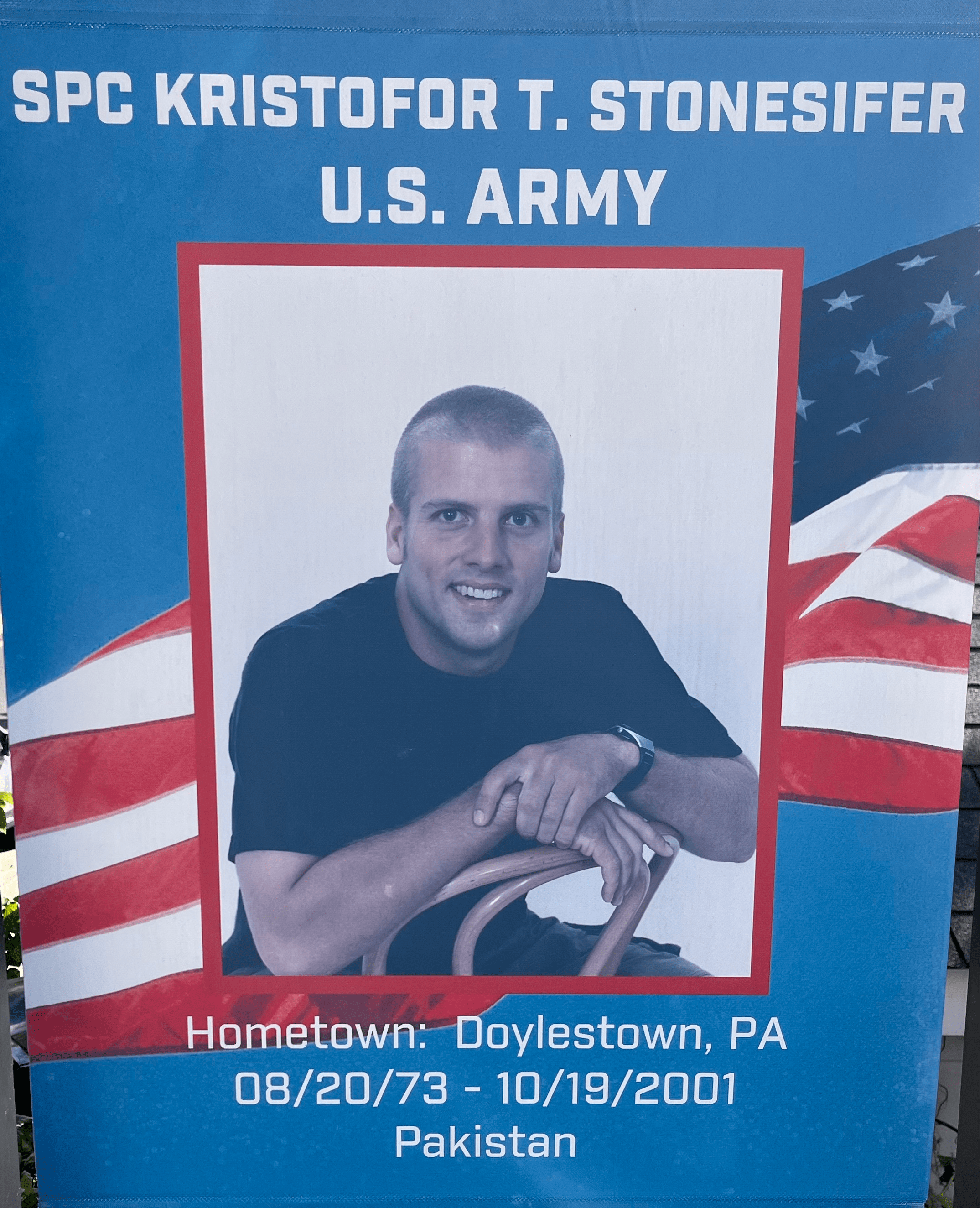
Kris Stonesifer was a curious and active kid. In our interview on Face Time, his mother Ruth described him as into everything. “From stunt riding bicycles to jujitsu, he was a black belt in karate very early on at the Y. He was an individual kind of sportsman. I always describe him as a vegan philosophy major” who loved the challenge of the outdoors. He went to a program in New Jersey to learn tracking and survival techniques.
“He lost a good friend to hypothermia. And that’s when he started to do all the tracking and survival training. He was unable to find his friend who passed away from hypothermia who had been out hiking in a state park. Ruth said that was turning point in Kris’s life. He wanted to be able to take care of himself.
Ruth and her family moved from Florida to Bucks County, PA when Kris was in the first grade. He graduated from CB West High School.
”He went on and off to college just to tease me. He knew the value of a college education, but it wasn’t the same value that most people put on it. He knew it was a gateway to learning things he wanted to learn about and not particularly a curriculum.”
Kris started at the University of Delaware, but he left and moved out to Montana with some from friends to go to college there.
”His whole goal was to be able to go into the wilderness, but make it with a knife. I made him promise to call me on his birthday. I had visions of Jeremiah Johnson coming out of the wilderness and begging someone for a quarter to use the pay phone.”
Kris joined ROTC at the University of Montana to help pay for school, but he was looking for something tougher. He enlisted in the army at twenty-seven, and went to Ranger school where he was on 9/11. “I remember we talked about it and he said a lot of good men are going to die.”
Kris had hurt his foot while training and it was in a cast. He cut the cast off so he wouldn’t be left behind when his unit was sent over to Afghanistan. Ruth didn’t even know Kris was sent overseas. She thought he was at Fort Benning in Georgia. She eventually got his last letter. “I don’t know if you’ll ever get an explanation of how or why I died. I’d like to think I died for something important or vital to the mission here. But I don’t think it is. It’s just a gravy mission and I fully expect to come back without firing a shot. So if you’re are reading this something went horribly wrong or it was just bad luck Murphy’s Law type fluke. All of you are in my thoughts. I’ve had a good life and I’m happy to have spent it with you. Love, Kris.”
In early October, 2001 Kris was stationed on the aircraft carrier USS Kitty Hawk. It was serving an afloat staging base for special operations helicopters and personnel. Kris and Spc Jonn Edmunds were assigned to a flex force designated as a mobility reserve to be within range of the target. They were headed to the Afghanistan border in southwest Pakistan. The Pakistani government allowed US forces to use a remote airstrip to attack the Taliban. The mission’s timing was dangerous. There were seasonal conditions known as the “Wind of 120 Days” that would kick up blinding sand storms.
At sunset on October 19th, 2001, Kris and Edmunds bordered their helicopter. After three hours of flying over water and mountains, they found the airstrip. There were no ground forces to secure the field. Kris and Edmunds sat in the door ready to jump off as the chopper landed. Seconds before touchdown, the Blackhawk helicopter was enveloped in a dust storm never seen before by these well trained crews that obliterated the crew’s vision. The helicopter drifted off course and hit a low sand dune and rolled over. Kris and Edmunds were killed when they were pinned under the helicopter. The first casualties of the war. Three other crew members survived.
Ruth remembers, “I couldn’t sleep that particular night, and I was watching CNN or something. And there was a ticker that went across the TV that said two Rangers were killed in a helicopter crash, and I thought all those poor families.”
I was working at Eyewitness News at the time. When the story broke, it was a big local story because Kris was from Doylestown.
The next morning she found out at work. A manager at her workplace approached her and asked her to follow him into a conference room. “I saw the man in the green uniform. He didn’t say anything. I knew I had to give him permission to tell me. He said are you Ruth Stonesifer? Do you have a son named Kristofor? And I didn’t hear anything after that.”
Having read a lot of what Ruth has written about Kris, I told her she seemed to have a very strong bond with him. “Well I would like to think so. I think I did it right. I didn’t want to see his dead body. I wanted to remember him alive. He’d be kicking my ass if I stayed home. He got out there and lived, so I’m sure that was what I wanted to do. I’m sure the message is the same for me. I miss him dearly. It seems like it’s just yesterday. Hopefully, someday there’s an afterlife and I’ll get to say hello to him again and have a good fifteen minute talk.”
Ruth along with some of Kris’s friends climbed up a mountain in Montana where Kris spent time hiking and exploring to spread his ashes. Ruth carried Kris’s ashes in his backpack.
“I went into training to walk that seven miles and two thousand feet up, and it was a nice time to spend with his friends.”
As we were coming to the end of our talk, Ruth said she started the military banners program in our area. She said there was a group in California who started the banners program there. She called to see if they could bring the program to Pennsylvania. “They said we’ll have to interview you. Okay, what do I have to do to pass this test? I hung up the phone and said I can do this myself.”
Ruth started making calls to Harrisburg contacting families in 2007 and got the ball rolling. She got one hundred-forty Gold Star Families to participate. Opening ceremonies were held in 2007 in Harrisburg. Later that year, a group Gold Star Families got the Bucks County Commissioners to start the banners project here.
A few months after Kris’s death, Ruth wrote, “He wouldn’t understand all the fuss being made over him. He would be amused and bewildered that so much attention was being made about his life and death…He would not define his death as a sacrifice for his country. It was just another day for him; to do the best job he could and protect his fellow Rangers to the best of his ability I believe Kris died for what he valued most, friendship and truth.”
Leave a Reply