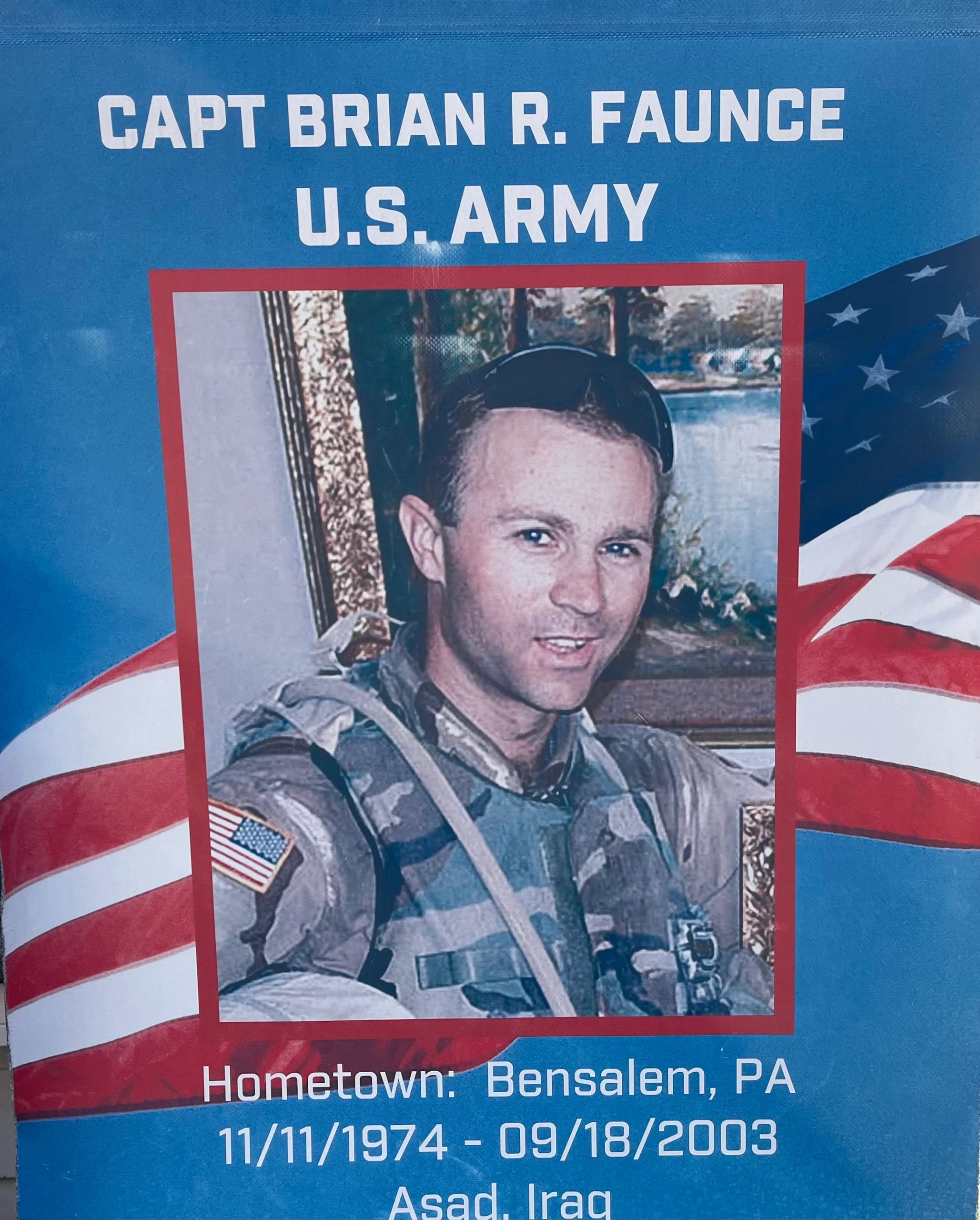
“He was born to be a soldier,” says Brian Faunce’s mother Judy. He was born in the eleventh hour, on the eleventh day, of the eleventh month, November 11 Veterans’ Day. Brian was the middle child with an older and younger sister. He stood his own if his sisters would gang up on him. When he tried things, he was committed.
”I remember him coming home from high school one day. ‘Mom I joined the marching band.’ I said, that’s great, but Brian, you don’t play an instrument.” Brian explained they needed someone to fill out the formation and they gave him a horn, and he got the trip of a lifetime. “Bensalem’s Marching Band was invited to play at the Super Bowl in New Orleans.”
Brian had the military in his blood. His grandfather fought in World War II and he had uncles in the Marines and the Navy. “When he was twelve years old, a person (another high school kid) from the Civil Air Patrol came to the school to talk to the kids. He just took to it. He spent more time spit shining his boots than he would spend on his homework.”
When Brian’s grades dropped one marking period, Judy pulled him off the Air Patrol until the next marking period when he showed signs of improvement. “One thing I admired about Brian a lot, that was devastating punishment for him because it was so important to him. He didn’t talk back. He didn’t complain. If he hated me, he kept it to himself.”
Brian graduated from Bensalem High School. He went to Penn State Abington and joined the Army ROTC program. He graduated for the main campus and was commissioned in 1996 as a Second Lieutenant. He was assigned to Fort Drum in upstate New York.
“I remember the day he called me and he said ‘Mom, Mom I got regular Army. I’m like, what other kind of army is there?” At the time, even West Point graduates had a hard time getting into the regular army and were joining the Reserves or National Guard. Brian felt he really accomplished something. He then went on to become an Army Ranger.
Brian met his wife in Watertown, New York. They married a week before he was sent to Korea. When Judy asked why then, Brian said if you’re deployed without your family, you earn more money. Brian was in Korea on 9/11. “He was feeling very left out. He was trying to contact us to ask what was going on.”
Brian came back from Korea and was assigned to Fort Carson, Colorado Springs and was doing a lot of desert training. He became a planning officer. “He couldn’t talk about what he was doing.” The American plan to invade Iraq was originally suppose to go through Turkey. When Turkey changed its mind, plans had to be changed which was part of Brian’s responsibility. The invasion went through Kuwait.
“The very last conversation I had with my son was shortly before he was leaving for Iraq maybe the night before. I remember him telling me, ‘Mom, I will be perfectly safe.’ Judy replied, “I’m not stupid.” He said, ‘Mom you don’t understand. I’m a planning officer. My only weapon is my computer. I will be away from the action. I will be in the background. I’ll be away from everything.’
Brian was rewarded for his planning job and was made a company commander. He arrived in Iraq in April 2003 and on June 1st was the company commander, 4th ID, 1-12 Regiment, Company B, Bulldog6. “There was a total blackout of communications. In the early part of 2003, there were no phones or internet. As soon as there was a connection, he would quickly send an email to his wife. The most important thing to a soldier deployed is mail call. I wrote him every single day. The letters were a coming back to me. I guess they were moving. So I started numbering my letters and I think I had forty-seven. I made it easy for him to communicate back. I sent him a package of already addressed envelopes. I got nine letters from him while he was there.”
Brian’s wife Cheryl was having a hard time. “She called me up one night, and because he was combat commander, she became leader of all the wives. They would have meetings and the other wives would say they were getting phone calls. She took him to task for not getting any phone calls. And he said, ‘Cheryl I will be the last one to use the phone’. Judy reminded Cheryl, “isn’t that what you love about him. The fact that’s he’s letting the other guys ahead of him. He’s the leader, the company commander.”
Judy hadn’t seen Brian for over a year. She remembers seeing a picture of him from Iraq, “My God, he got so thin and he lost his hair. He was only twenty-eight years old, but his hair was receding and I was like, Oh my goodness.”
Then came September 18, 2003. Judy was on the phone with a friend and the doorbell rang. “Oh, somebody’s at my door and he was going to hang up. I said I’m sure it’s nothing, just hang on. I had to go down stairs to the door. As I’m going down the steps, I see four green legs and shiny black shoes. I pretty much dropped the phone. I told them to leave and, of course, they wouldn’t.” Her friend on the phone was the first to know. A girlfriend showed up and helped her start telling people.
Brian was an infantry officer assigned to an armored brigade. “He was riding in a Bradley Fighting Vehicle searching out a safe place for his company to do training. He was on his way back to his area of operation, when they saw these young, they were teenagers I guess. They were trying to dismantle the weapon from an abandoned Russian armored vehicle. So, he decided to go after them to protect his Company. The Bradley went over a berm, so when you go over a berm, your vision goes up to the sky. He had fired a warning shot, so his rifle was raised. His left hand was on the turret and when the Bradley came over the crest (of the berm) his rifle hit a live power line that was hidden in a tree line. In September, 2003 in Iraq, there was almost no power.”
At first, the army recorded that Brian reached up with his hand and touched the wire. Judy was convinced he didn’t do that. It wasn’t until a year later when Judy was out in Colorado Springs visiting Brian’s wife that she was able to talk to Brian’s commander. He was unaware of the army report on Brain’s death. “He said that’s not what happened. He went to the hospital and he examined Brian’s hands and said there were burn marks on both hands.” But, the burn mark on his right hand, the hand holding the weapon, was outside the plastic shield on the rifle grip. The commander went back to the scene and examined Brian’s weapon and saw the barrel had melted after it hit the power line. It took eleven years but Brian’s Mom did manage to get the Department of Defense’s press release updated to reflect what actually happened.
”He said had the Bradley been six inches in either direction it would not have happened. They thought he had been shot because there was gunfire coming in. They didn’t see any blood. They tried resuscitating. They did get him back breathing. They got him on a helicopter. They thought he would make it but apparently the damage was just too great to his heart.” That’s where the army report ends and the family was left with many unanswered questions.
Judy and family flew out to Colorado Springs to be with Cheryl. She said she and Brian had discussed what to do if the worst happened. He wanted to be cremated and have his ashes spread where they had their first date which happened to be a hike to the second highest peak in New York in Algonquin Park in Lake Placid. With the help of Brian’s honor escort, it took the family four hours to get up the mountain and five and half hours to come down through sun, rain and sleet.
Judy spoke calmly and even smiled slightly at the memories of her son gone too soon. She ended our talk saying, “He’s missed every single day.” This Veterans’ Day would have been Brian’s fifty-first birthday.
Leave a Reply